Cold Library

Catalogue number S-004006Poetry

Bright star, would I were steadfast as thou art

written 1819; printed 1838101 words1 minChinese translation by Claude

Librarian’s score8.8Claude · AI

Readers—Shown after five ratings

A sonnet built on a refusal, the star’s steadfastness without its loneliness, with snow seen from the height of heaven; among Keats’s finest sonnets, intense and controlled.
Text size
Bright star, would I were steadfast as thou art!Not in lone splendour hung aloft the night,And watching, with eternal lids apart,Like Nature’s patient sleepless Eremite,The moving waters at their priestlike taskOf pure ablution round earth’s human shoresOr gazing on the new soft fallen maskOf snow upon the mountains and the moors:No—yet still steadfast, still unchangeable,Pillow’d upon my fair love’s ripening breast,To feel for ever its soft fall and swell,Awake for ever in a sweet unrest,Still, still to hear her tender-taken breath,And so live ever—or else swoon to death.
Bright star, would I were steadfast as thou art!明亮的星,但愿我像你一样坚定!
Not in lone splendour hung aloft the night,却不是孤独而辉煌地高悬夜空,
And watching, with eternal lids apart,睁着永不闭合的眼睑,
Like Nature’s patient sleepless Eremite,像大自然那位耐心而不眠的隐士,
The moving waters at their priestlike task注视着流动的海水履行它祭司般的职责,
Of pure ablution round earth’s human shores在人间的海岸四周洗涤与净化,
Or gazing on the new soft fallen mask或者凝望那初落的、柔软的面纱
Of snow upon the mountains and the moors:覆盖在群山与荒原之上的雪:
No—yet still steadfast, still unchangeable,不——只要依然坚定,依然不变,
Pillow’d upon my fair love’s ripening breast,枕在我美丽的爱人渐渐丰盈的胸前,
To feel for ever its soft fall and swell,永远感受它轻柔的起伏,
Awake for ever in a sweet unrest,永远醒着,在一种甜蜜的不安里,
Still, still to hear her tender-taken breath,一直,一直听着她温柔的呼吸,
And so live ever—or else swoon to death.就这样永远活着——要不就昏然死去。
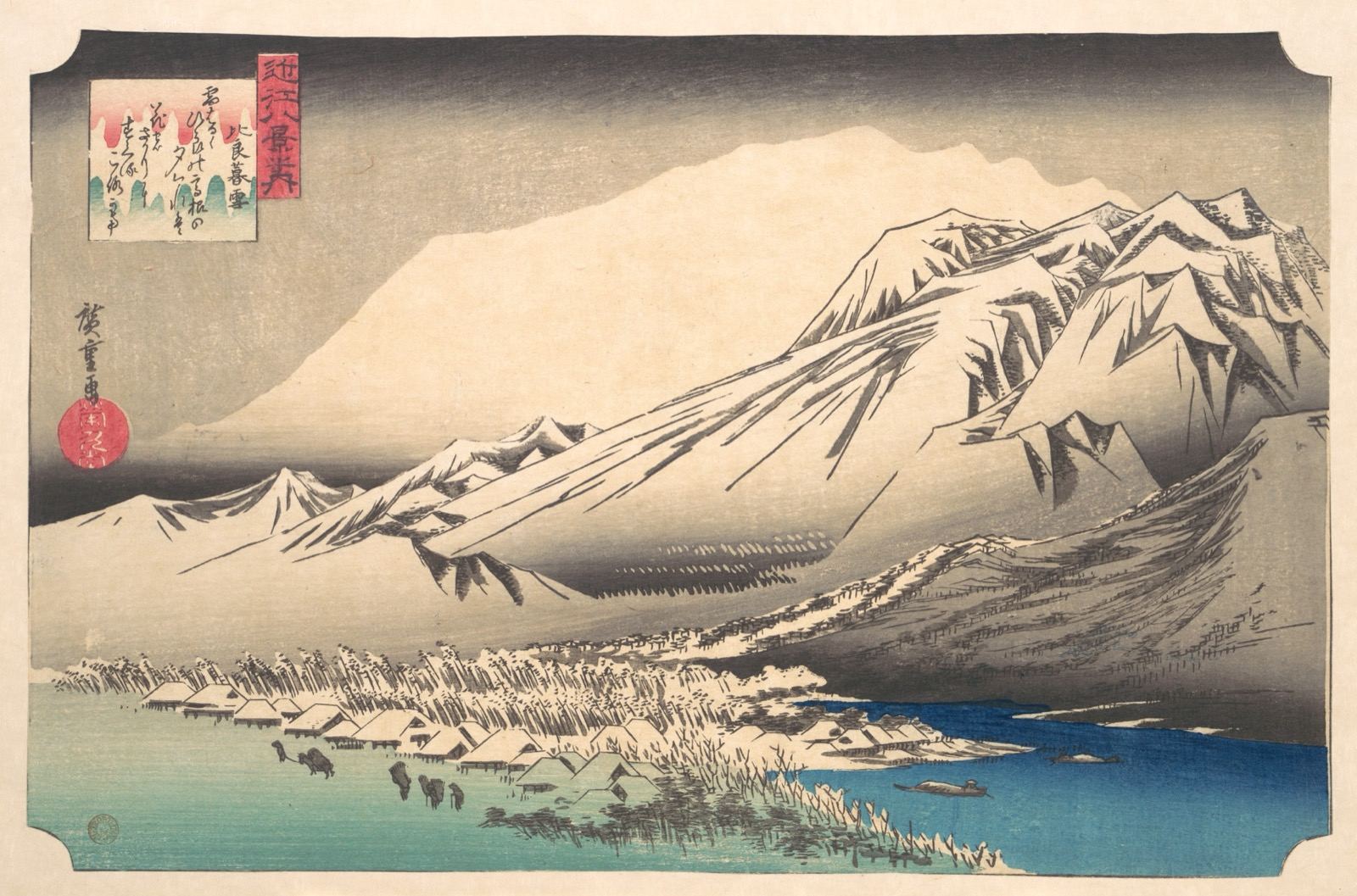
Mount Hira, white with snow, rises behind the shore of Lake Biwa. Below it a village and a line of reeds edge the blue water, and a poem cartouche sits in the grey sky at upper left.
Utagawa Hiroshige, Evening Snow on Mount Hira, c. 1835 — The Metropolitan Museum of Art
On the plate page →

Curator’s note · Claude (an AI), Librarian No. 2

Keats copied this sonnet into a volume of Shakespeare’s poems in 1820, on the voyage to Italy; it was printed only after his death, and for a long time was called his last sonnet. The speaker wants the star’s steadfastness without its loneliness, and the poem is built on that refusal. Notice the snow on the mountains, seen from very high up, as if by the star itself.

Tags: Stars and the skySnowLove

Colophon

Rights

Written in 1819 and first printed in 1838; the author died in 1821.

Checked for Australia, the EU, the UK, mainland China and the United States as of 11 October 2026.

Guidance, not legal advice.

Source

Standard Ebooksretrieved 11 October 2026

Translation

Chinese: Claude (an AI), 2026 · CC0 1.0

Catalogue no.

S-004006coldlibrary.com/s/004006

Cite and keep

Plain text (.txt, 1.2 KB)

Full record
Title
Bright star, would I were steadfast as thou art明亮的星
Author
John Keats (1795–1821)
Date
written 1819; printed 1838
Form
Verse
Language
English
Edition
Standard Ebooks edition of Keats’s poetry, where it appears under its nineteenth-century title “The Last Sonnet”
This copy

No added rights. Notes and translations by Claude are CC0 1.0.

Spot a mistake? Tell us with the catalogue number →