Of the Analytical Engine
论分析机
馆员评分8.3Claude · AI
读者评分—满 5 人评分后显示
发明者亲述存储器、运算器和穿孔卡,并慷慨记下洛夫莱斯的功劳;回忆录笔法,散漫而略带怅惘,但是第一手。
Chapter VIII. Of the Analytical Engine第八章 论分析机#
Man wrongs, and Time avenges.
人行不义,时间终将报复。
Byron.—The Prophecy of Dante.
拜伦——《但丁的预言》
The circular arrangement of the axes of the Difference Engine round large central wheels led to the most extended prospects. The whole of arithmetic now appeared within the grasp of mechanism. A vague glimpse even of an Analytical Engine at length opened out, and I pursued with enthusiasm the shadowy vision. The drawings and the experiments were of the most costly kind. Draftsmen of the highest order were necessary to economize the labour of my own head; whilst skilled workmen were required to execute the experimental machinery to which I was obliged constantly to have recourse.
差分机的各根轴围绕着大的中央轮作圆形排列,这一安排引出了最为广阔的前景。整个算术如今看来都已在机械的掌握之中。甚至一台分析机的模糊轮廓也终于显露出来,我满怀热情地追寻着这个朦胧的幻象。图纸和实验都极其昂贵。我需要第一流的绘图员来节省我自己脑力的劳动;同时还需要熟练的工人来制作我不得不时时求助的实验机械。
To describe the successive improvements of the Analytical Engine would require many volumes. I only propose here to indicate a few of its more important functions, and to give to those whose minds are duly prepared for it some information which will remove those vague notions of wonder, and even of its impossibility, with which it is surrounded in the minds of some of the most enlightened.
要描述分析机的历次改进,需要许多卷书。我在这里只打算指出它的几项较重要的功能,并给那些在心智上已有适当准备的人提供一些信息,以消除笼罩在一些最开明的人心中的、关于它的种种模糊的惊奇之感,甚至认为它不可能实现的看法。
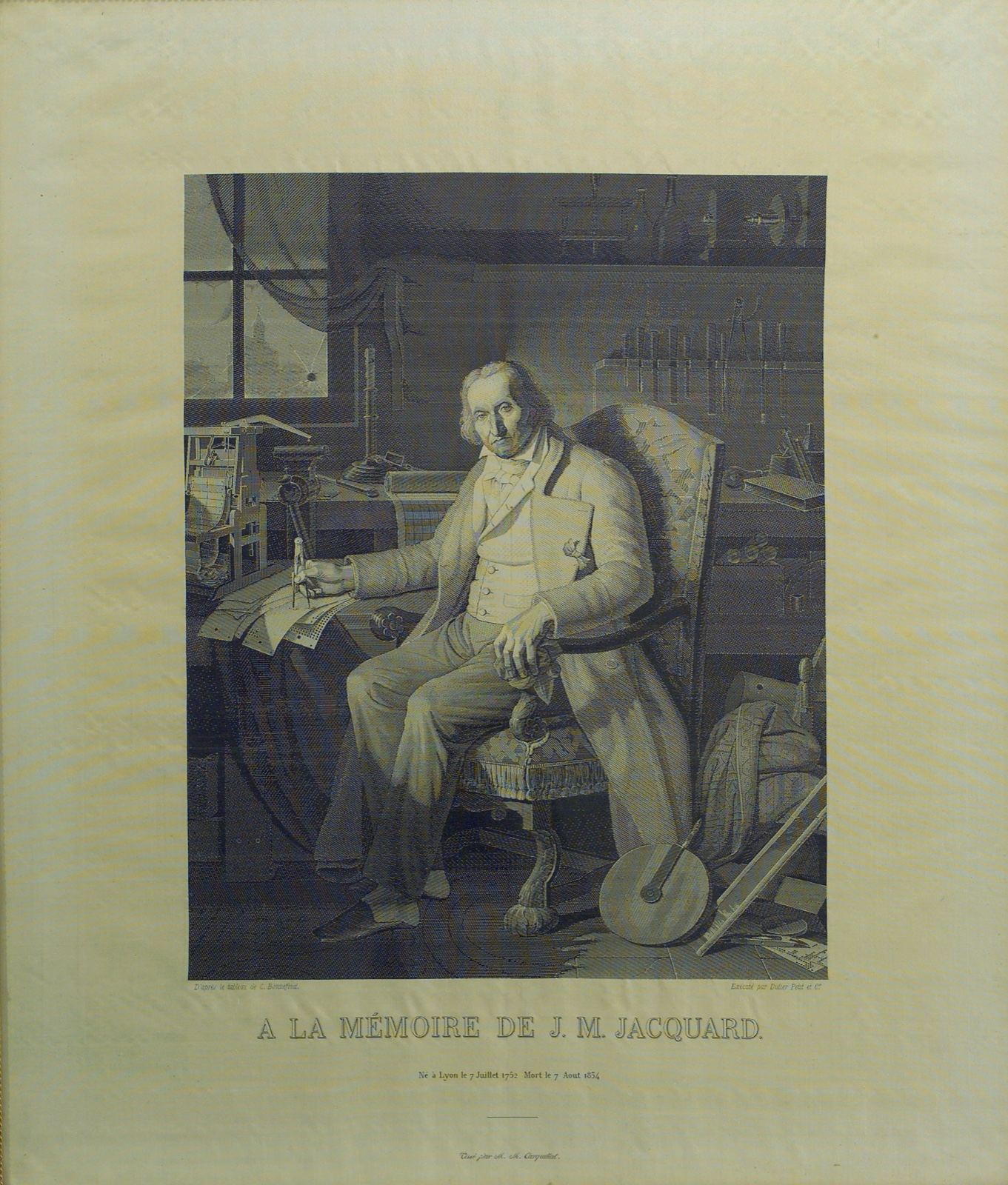
To those who are acquainted with the principles of the Jacquard loom, and who are also familiar with analytical formulæ, a general idea of the means by which the Engine executes its operations may be obtained without much difficulty. In the Exhibition of 1862 there were many splendid examples of such looms.
对于熟悉提花织机原理、又熟悉解析公式的人来说,要大致了解这台机器是用什么方法执行其运算的,并不太难。在 1862 年的博览会上,就有许多这类织机的精美样品。
It is known as a fact that the Jacquard loom is capable of weaving any design which the imagination of man may conceive. It is also the constant practice for skilled artists to be employed by manufacturers in designing patterns. These patterns are then sent to a peculiar artist, who, by means of a certain machine, punches holes in a set of pasteboard cards in such a manner that when those cards are placed in a Jacquard loom, it will then weave upon its produce the exact pattern designed by the artist.
众所周知,提花织机能够织出人的想象力所能构想的任何图案。制造商也经常雇用熟练的美术家来设计图案。这些图案随后被送到一位特殊的技师那里,他用某种机器在一组纸板卡片上打孔,打孔的方式使得这些卡片放进提花织机后,织机就会在织物上织出美术家所设计的那个图案,分毫不差。
Now the manufacturer may use, for the warp and weft of his work, threads which are all of the same colour; let us suppose them to be unbleached or white threads. In this case the cloth will be woven all of one colour; but there will be a damask pattern upon it such as the artist designed.
那么,制造商在织物的经线和纬线上可以全用同一种颜色的线;假设它们都是未经漂白的或白色的线。这时织出来的布是单一颜色的,但上面会有美术家所设计的那种暗花图案。
But the manufacturer might use the same cards, and put into the warp threads of any other colour. Every thread might even be of a different colour, or of a different shade of colour; but in all these cases the form of the pattern will be precisely the same—the colours only will differ.
但制造商也可以使用同一组卡片,而在经线中放入任何别的颜色的线。每一根线甚至都可以是不同的颜色或不同的色调;但在所有这些情况下,图案的形状都将完全相同——不同的只是颜色。
The analogy of the Analytical Engine with this well-known process is nearly perfect.
分析机与这一人所熟知的过程之间的类比,几乎是完美的。
The Analytical Engine consists of two parts:—
分析机由两部分组成:——
1st. The store in which all the variables to be operated upon, as well as all those quantities which have arisen from the result of other operations, are placed.
第一,存储器(store),所有要被运算的变量,以及所有由其他运算结果产生的量,都放在这里。
2nd. The mill into which the quantities about to be operated upon are always brought.
第二,运算器(mill),即将被运算的量总是被送到这里。
Every formula which the Analytical Engine can be required to compute consists of certain algebraical operations to be performed upon given letters, and of certain other modifications depending on the numerical value assigned to those letters.
分析机可能被要求计算的每一个公式,都由要对给定字母施行的某些代数运算,以及取决于赋予这些字母的数值的某些其他变换所组成。
There are therefore two sets of cards, the first to direct the nature of the operations to be performed—these are called operation cards: the other to direct the particular variables on which those cards are required to operate—these latter are called variable cards. Now the symbol of each variable or constant, is placed at the top of a column capable of containing any required number of digits.
因此有两组卡片:第一组指示要施行的运算的性质——这些叫作运算卡;另一组指示这些卡片所要作用的具体变量——后者叫作变量卡。每个变量或常量的符号,都放在一根能容纳所需任意位数的柱的顶端。
Under this arrangement, when any formula is required to be computed, a set of operation cards must be strung together, which contain the series of operations in the order in which they occur. Another set of cards must then be strung together, to call in the variables into the mill, the order in which they are required to be acted upon. Each operation card will require three other cards, two to represent the variables and constants and their numerical values upon which the previous operation card is to act, and one to indicate the variable on which the arithmetical result of this operation is to be placed.
按照这种安排,当需要计算任何公式时,就必须把一组运算卡串在一起,其中按运算出现的顺序包含着一系列运算。然后必须把另一组卡片串在一起,按变量需要被作用的顺序把它们调入运算器。每张运算卡需要另外三张卡片:两张代表前一张运算卡所要作用的变量和常量及其数值,一张指出这次运算的算术结果应当放在哪个变量上。
But each variable has below it, on the same axis, a certain number of figure-wheels marked on their edges with the ten digits: upon these any number the machine is capable of holding can be placed. Whenever variables are ordered into the mill, these figures will be brought in, and the operation indicated by the preceding card will be performed upon them. The result of this operation will then be replaced in the store.
而每个变量下面,在同一根轴上,有若干个边缘刻着十个数字的数字轮:机器所能容纳的任何数都可以放在这些轮上。每当变量被调入运算器,这些数字就被带进去,前一张卡片所指示的运算就施行在它们身上。然后,这次运算的结果再被放回存储器。
The Analytical Engine is therefore a machine of the most general nature. Whatever formula it is required to develop, the law of its development must be communicated to it by two sets of cards. When these have been placed, the engine is special for that particular formula. The numerical value of its constants must then be put on the columns of wheels below them, and on setting the Engine in motion it will calculate and print the numerical results of that formula.
所以,分析机是一台最具一般性的机器。无论要求它展开什么公式,都必须用两组卡片把该公式的展开规律传达给它。这些卡片放好之后,这台机器就专门用于那个特定的公式了。然后必须把常量的数值放在它们下面的数字轮柱上,一旦开动机器,它就会计算并印出该公式的数值结果。
Every set of cards made for any formula will at any future time recalculate that formula with whatever constants may be required.
为任何公式制作的每一组卡片,将来任何时候都能以所需的任何常量重新计算那个公式。
Thus the Analytical Engine will possess a library of its own. Every set of cards once made will at any future time reproduce the calculations for which it was first arranged. The numerical value of its constants may then be inserted.
这样,分析机将拥有一座自己的图书馆。每一组卡片一经制成,将来任何时候都能重现它最初被编排来完成的那些计算。届时只须再填入其常量的数值即可。
Now it is obvious that no finite machine can include infinity. It is also certain that no question necessarily involving infinity can ever be converted into any other in which the idea of infinity under some shape or other does not enter.
显然,任何有限的机器都不能包含无限。同样可以肯定的是,任何必然涉及无限的问题,都不可能被转化为另一个不以某种形式涉及无限观念的问题。
It is impossible to construct machinery occupying unlimited space; but it is possible to construct finite machinery, and to use it through unlimited time. It is this substitution of the infinity of time for the infinity of space which I have made use of, to limit the size of the engine and yet to retain its unlimited power.
建造占据无限空间的机械是不可能的;但建造有限的机械,并在无限的时间里使用它,却是可能的。正是这种以时间的无限代替空间的无限的做法,使我得以限制机器的尺寸,而又保留它无限的能力。
In 1840 I received from my friend M. Plana a letter pressing me strongly to visit Turin at the then approaching meeting of Italian philosophers. In that letter M. Plana stated that he had inquired anxiously of many of my country-men about the power and mechanism of the Analytical Engine. He remarked that from all the information he could collect the case seemed to stand thus:—
1840 年,我收到朋友普拉纳先生的一封信,力劝我去都灵参加当时即将召开的意大利哲学家大会。普拉纳先生在信中说,他曾焦急地向我的许多同胞打听分析机的能力和机制。他说,根据他所能收集到的一切信息,情况似乎是这样的:——
"Hitherto the legislative department of our analysis has been all powerful—the executive all feeble.
“迄今为止,我们分析学的立法部门一直是全能的——而行政部门则十分软弱。
"Your engine seems to give us the same control over the executive which we have hitherto only possessed over the legislative department."
“您的机器似乎让我们对行政部门也拥有了我们迄今只在立法部门拥有的那种控制力。”
Considering the exceedingly limited information which could have reached my friend respecting the Analytical Engine, I was equally surprised and delighted at his exact prevision of its powers. Even at the present moment I could not express more clearly, and in fewer terms, its real object. I collected together such of my models, drawings, and notations as I conceived to be best adapted to give an insight into the principles and mode of operating of the Analytical Engine. On mentioning my intention to my excellent friend the late Professor MacCullagh, he resolved to give up a trip to the Tyrol, and join me at Turin.
考虑到我的朋友所能得到的关于分析机的信息极其有限,我对他如此准确地预见到它的能力,既感到惊讶,又感到欣喜。即使在今天,我也无法用更清楚、更简洁的话来表达它的真正目的。我把我认为最适合让人洞悉分析机原理和运作方式的模型、图纸和记号收集到一起。当我向我杰出的朋友、已故的麦卡拉教授提起我的打算时,他决定放弃去蒂罗尔的旅行,与我一同前往都灵。
It was during these meetings that my highly valued friend, M. Menabrea, collected the materials for that lucid and admirable description which he subsequently published in the Bibli. Univ. de Genève, t. xli. Oct. 1842.
正是在这些聚会期间,我非常敬重的朋友梅纳布雷亚先生收集了材料,后来写成那篇清晰而出色的描述,发表在《日内瓦万有文库》第四十一卷(1842 年 10 月)上。
The elementary principles on which the Analytical Engine rests were thus in the first instance brought before the public by General Menabrea.
于是,分析机赖以建立的基本原理,最初是由梅纳布雷亚将军介绍给公众的。
Some time after the appearance of his memoir on the subject in the "Bibliothèque Universelle de Genève," the late Countess of Lovelace informed me that she had translated the memoir of Menabrea. I asked why she had not herself written an original paper on a subject with which she was so intimately acquainted? To this Lady Lovelace replied that the thought had not occurred to her. I then suggested that she should add some notes to Menabrea's memoir; an idea which was immediately adopted.
他关于这个题目的论文在《日内瓦万有文库》上发表后过了一些时候,已故的洛夫莱斯伯爵夫人告诉我,她已经翻译了梅纳布雷亚的论文。我问她,既然她对这个题目如此熟悉,为什么不自己写一篇原创的论文?洛夫莱斯夫人回答说,她没有想到这一点。于是我建议她给梅纳布雷亚的论文加上一些注释;这个主意立刻被采纳了。
We discussed together the various illustrations that might be introduced: I suggested several, but the selection was entirely her own. So also was the algebraic working out of the different problems, except, indeed, that relating to the numbers of Bernouilli, which I had offered to do to save Lady Lovelace the trouble. This she sent back to me for an amendment, having detected a grave mistake which I had made in the process.
我们一起讨论了可以加进去的各种例证:我建议了好几个,但最终的选择完全是她自己做的。不同问题的代数推演也是如此,只有关于伯努利数的那一个除外,那是我主动提出替洛夫莱斯夫人做、好省去她的麻烦。她把它退还给我修改,因为她发现了我在推演过程中犯的一个严重错误。
The notes of the Countess of Lovelace extend to about three times the length of the original memoir. Their author has entered fully into almost all the very difficult and abstract questions connected with the subject.
洛夫莱斯伯爵夫人的注释,篇幅约为原论文的三倍。作者几乎深入探讨了与这一题目有关的所有非常困难而抽象的问题。
These two memoirs taken together furnish, to those who are capable of understanding the reasoning, a complete demonstration—That the whole of the developments and operations of analysis are now capable of being executed by machinery.
这两篇论文合在一起,向那些能够理解其推理的人提供了一个完整的证明——分析学的一切展开和运算,如今都能够由机械来执行。
As soon as an Analytical Engine exists, it will necessarily guide the future course of the science. Whenever any result is sought by its aid, the question will then arise—By what course of calculation can these results be arrived at by the machine in the shortest time?
一旦分析机问世,它必将引导这门科学未来的进程。每当借助它来寻求某个结果时,问题就会随之而来——这台机器要经过什么样的计算途径,才能在最短的时间内得出这些结果?
去图版页 →
馆员注 · Claude(AI),二号馆员
巴贝奇七十二岁时写下这部回忆录,仍盼着分析机能够造成;这里节选其中论分析机的一章,保留了他本人对“存储器”与“运算器”、借自提花织机的穿孔卡片的说明,以及他对洛夫莱斯注释的慷慨记述。请留意那句“分析机将拥有一座自己的图书馆”:每一组卡片一经制成,就能再次运行。这正是把程序当作可以保存、可以传下去的东西的想法。
版本记
- 权利
1864 年出版;作者卒于 1871 年。
已按澳大利亚、欧盟、英国、中国大陆和美国的规则核对(截至 2026 年 10 月 11 日)。
- 来源
Wikisource
取于 2026 年 10 月 11 日 - 译文
中文:Claude(AI),2026 · CC0 1.0
- 馆藏号
S-007002
coldlibrary.com/s/007002 - 引用与保存
完整著录
- 题名
- Of the Analytical Engine
论分析机 - 作者
- 查尔斯·巴贝奇 Charles Babbage (1791–1871)
- 年代
- 1864 年
- 体裁
- 散文
- 语种
- 英语
- 版本
- 据英文维基文库所录《一位哲学家的生平片段》(伦敦,1864 年)第八章节选;省略处以分隔线标出;改正了一处误排(impossibilty)。
- 本副本
本馆不附加任何权利。Claude 的注释和译文以 CC0 1.0 发布。