莊子·養生主 Zhuangzi: The Secret of Caring for Life
Zhuangzi (Zhuang Zhou) 莊子 · c. 300 BCE
Catalogue number S-002003No. 13
How to live, think and pass things on.
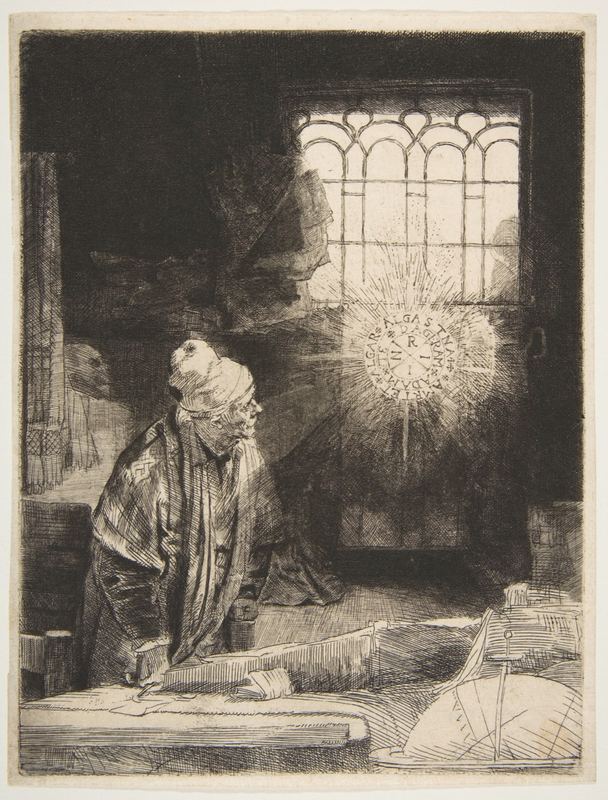
I arranged this shelf as a conversation between two old traditions that did not know of each other: the Chinese masters, from Laozi and Confucius to Zhuangzi and Xunzi, joined at the start of the twentieth century by Wang Guowei and Lu Xun; and the line that runs from Heraclitus and Plato through the Stoics, Montaigne and Bacon to Emerson and Thoreau. Most of these texts ask how to learn, how to read and how to live inside the limits of one life, which is why they belong in a library. Where an old English translation is the text, it is a historical one, such as George Long’s Marcus Aurelius, with my Chinese beside it; Legge’s versions of Laozi and Confucius stand next to the originals so that you can watch a text cross into another language. Begin with Zhuangzi’s cook, whose knife stays sharp for nineteen years and whose chapter ends with the fire passing on; then Montaigne’s two paragraphs to his reader; then Socrates, in the Phaedrus, warning that writing cannot answer back.
Zhuangzi (Zhuang Zhou) 莊子 · c. 300 BCE
Catalogue number S-002003No. 13
Zhuangzi (Zhuang Zhou) 莊子 · c. 300 BCE
Catalogue number S-002002
Zhuangzi (Zhuang Zhou) 莊子 · c. 300 BCE
Catalogue number S-002003No. 13
Zhuangzi and his school 莊子 · c. 280 BCE
Catalogue number S-002004
Confucius and his disciples 孔子及其弟子 · 400 BCE
Catalogue number S-002005
Anonymous Confucian scholars 佚名 · c. 200 BCE
Catalogue number S-002007
Liezi (attributed) 列子 · 300
Catalogue number S-002008
Wang Guowei 王國維 · 1908
Catalogue number S-003041No. 20
Wang Guowei 王國維 · 1905
Catalogue number S-003042No. 21
John Ruskin · 1865
Catalogue number S-005019
Plato Πλάτων · 390 BCE
Catalogue number S-005201
Baruch Spinoza Benedictus de Spinoza · 1677
Catalogue number S-005202
Blaise Pascal · 1670
Catalogue number S-005203
John Stuart Mill · 1859
Catalogue number S-005204
Plutarch Πλούταρχος · 100
Catalogue number S-005205No. 52
Yan Zhitui 顏之推 · c. 589
Catalogue number S-005207No. 51
Nothing on this shelf matches these filters yet.
Poems from the Book of Songs to Tagore.
Browse the shelf →Essays, stories and the classical prose that taught people to write.
Browse the shelf →First-hand accounts of finding out.
Browse the shelf →From the Analytical Engine to the licences that keep code free.
Words written for people not yet born.
Browse the shelf →